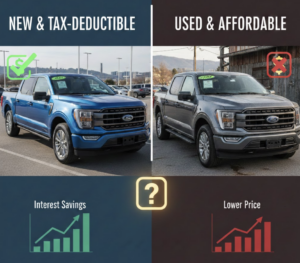
 Many are starting to hear about the new car loan tax deduction passed in the “One Big Beautiful Bill” (OBBBA). This is a new federal tax deduction for interest paid on personal vehicle loans. Buying a vehicle is a major financial decision, especially given the record transaction prices in recent years. In 2026, the math has changed significantly.
We are here to do a fresh breakdown of new versus lightly used with the new tax incentives in mind. The questions we are trying to answer? Is it more advantageous to buy new versus used in 2026?
The Personal Interest Deduction (New for 2026)
Historically, you could only deduct car loan interest if the vehicle was used for business. That changed with the OBBBA. For the tax years 2025 through 2028, you can now deduct interest on personal car loans, similar to a mortgage interest deduction.
What Vehicles Qualify?
To claim the personal interest deduction, the vehicle and the loan must meet strict criteria:
Must be “New”: The vehicle must be brand new (you must be the original owner). Used or “certified pre-owned” vehicles do not qualify for this personal interest deduction.
Made in America: The vehicle’s final assembly must have occurred in the United States. You can verify this by checking the VIN (Vehicle Identification Number) on the door jamb or using the NHTSA online decoder.
Weight Limit: The Gross Vehicle Weight Rating (GVWR) must be less than 14,000 lbs. This covers almost all cars, SUVs, and trucks (even most heavy duty trucks).
Loan Specifics: The loan must have been originated after December 31, 2024, and must be secured by the vehicle itself (personal unsecured loans don’t count).
The Limits
Maximum Deduction: You can deduct up to $10,000 in interest annually.
Income Caps: The deduction begins to phase out if your Modified Adjusted Gross Income (MAGI) exceeds $100,000 (Single) or $200,000 (Joint).
The Business Angle (Section 179)
A lot of confusion exists between this new program and the existing depreciation write off for business owners. If you are buying a vehicle for business use (more than 50% of the time), you have a different set of tools: Section 179 and Bonus Depreciation.
Section 179: Allows you to deduct the purchase price of the vehicle upfront. For 2026, the maximum deduction is $2,560,000, though specific limits apply based on the vehicle’s weight.
Bonus Depreciation: For 2026, bonus depreciation is at 20% (unless specific temporary extensions apply), which allows you to write off a percentage of the remaining cost after the Section 179 deduction.
New vs. Lightly Used: Which is Better?
Back to personal use, choosing between a new car and a “lightly used” one used to be a simple debate about depreciation. In 2026, the tax deduction seemingly shifts the balance.
Case Study
Let’s look at perhaps the most popular scenario with the best selling vehicle in the US. We took a bran new F150 and pit it against a lightly used two year old similarly equipped model.
| Feature | 2026 Ford F-150 XLT Crew (New) | 2024 Ford F-150 XLT Crew (Used) |
| Est. Purchase Price | $52,000 | $41,500 (30k Miles) |
| Loan Amount (20% Down) | $41,600 | $33,200 |
| Interest Rate | 4% | 4% |
| Tax Deduction Eligibility | Eligible (U.S. Assembled) | NOT Eligible |
The Deduction Calculation (New Vehicle)
Since the F-150 is assembled in Dearborn, MI, or Kansas City, MO, it qualifies for the OBBBA deduction. This allows you to deduct up to $10,000 in interest annually through the 2028 tax year.
Assuming a 60-month loan at 4% on the new 2026 model, your interest payments would look like this:
Total Write Off (2026–2028): $3,900 (keep reading, that is not cash in pocket)
Real-World Tax Savings
A deduction isn’t a credit, it lowers your taxable income. If you are in the 22% tax bracket, that $3,900 deduction results in roughly $858 in actual cash savings over three years. That $3,000 difference certainly changes the equation!
The AccuroWealth Verdict: Is New Worth It?
To determine if the new truck is financially advantageous, we look at the Total Cost of Ownership (TCO) for the first three years:
Buying New (2026 F-150)
- Sticker Premium: You are paying $10,500 more than the used price.
- Tax Benefit: You get $858 back in tax savings.
- Warranty/Maintenance: You have a full 3-year factory warranty (likely saving $1,000–$2,000 in potential repairs vs. a truck with 30k miles).
- Net “Loss” vs Used: ~$7,600 higher cost.
Buying Used (2024 F-150)
- Interest Deduction: $0.
- Depreciation: Much lower. The biggest “hit” (the first 2 years) has already been taken by the previous owner.
- Net Savings: You are still roughly $7,000 to $8,000 ahead by buying used, even without the tax break.
In this scenario, math certainly wins. You are still far better off buying used over new and letting the first owner take the depreciation hit.